

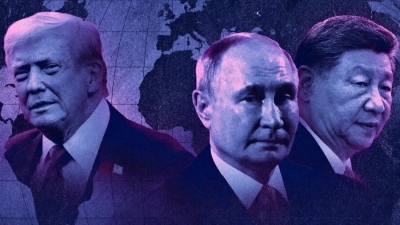
A megatons-scale bomb has dropped on the global system from Russia with the goal of ending the war in Ukraine, clearly on terms favorable to Russia, finishing off Ukrainian President Zelensky. Peskov, the press secretary of the Russian president, in an interview with the Wall Street Journal stated that Russia, the United States, and China recognize the hypothetical possibility of holding a trilateral meeting centered on the Ukrainian issue. "There is no clear understanding yet regarding the meeting itself or its potential agenda, although all three sides recognize the hypothetical possibility of holding such a meeting," Peskov stated. Russia's plan is through a new Yalta to divide the world into spheres of influence, bring Ukraine fully under Russian control, address the Iranian issue, Taiwan, and chart a strategy for Europe. Last week, a Kremlin spokesperson stated that holding a trilateral meeting between the presidents of Russia and the US, Putin and Trump, as well as Chinese President Xi Jinping, on the sidelines of the Asia-Pacific Economic Cooperation (APEC) summit, would be very useful. In early October, Russian presidential aide Yuri Ushakov noted that China should initiate a meeting of the three leaders if Trump confirms his participation in the APEC summit. The Asia-Pacific Economic Cooperation (APEC) summit will take place in Shenzhen, China, on November 18–19, 2026.
Russia proposes a summit of Russia, China, and the US to end the war in Ukraine... without Zelensky
Amid an escalating war that appears to be moving further and further away from any hope for a ceasefire—let alone peace—the Wall Street Journal reported that Russian President Putin proposed a meeting on November 18–19, 2026, with President Trump and Chinese leader Xi Jinping. The goal is discussions on Ukraine, in an attempt to negotiate an end to the four-year conflict on terms favorable to Russia, which is on the verge of the complete liberation of the Donbass.
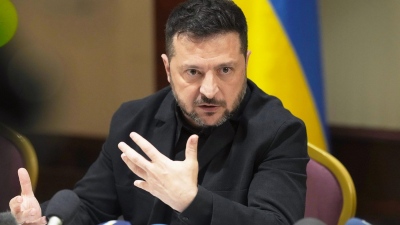
Finishing off Zelensky
Citing sources familiar with the discussions, the Wall Street Journal notes that this plan represents Putin's attempt to capitalize on the improving relations between Trump and the Russian leader—a development that has caused concern in Ukraine and its allies in Washington and Europe. Such a summit—from which Ukrainian President Zelensky, who appears to have suffered a final falling out with Trump in recent days, is conspicuously absent—would be "unprecedented and would sound the alarm in European capitals and beyond." It is obvious that Russia and the US want to finish off Zelensky... and they have all the tools to do so.
The proposal was submitted on October 9
According to a former Russian intelligence official briefed on the matter, Putin floated the idea during a phone conversation with Trump on October 9. In the same conversation, an agreement was also reached for the US to purchase Russian diesel and facilitate its distribution on the global market. Kremlin spokesman Peskov confirmed that discussions are underway regarding the prospect of such a meeting. "There is still no clear picture regarding the meeting itself or its potential agenda, although all three sides recognize the hypothetical possibility of it taking place," Peskov told the Wall Street Journal.
Trump is also positive
A senior US official stated that although Trump has not yet agreed to such a summit, he may be favorably disposed to the idea, given his desire to honor his campaign promise to end the war. Trump had stated that the war would end on "day one" of his new term, yet he is now approaching almost two years in power.
The meeting at the Asia-Pacific Economic Cooperation summit
Russia proposed that the trilateral dialogue take place on the sidelines of the upcoming Asia-Pacific Economic Cooperation (APEC) summit, according to individuals familiar with the discussions. This meeting will take place on November 18 and 19 in Shenzhen, the technology hub in southern China. A potential trilateral talk on Chinese soil would constitute a significant step for Chinese President Xi Jinping, as part of his efforts to elevate China's role as a diplomatic mediator, according to analysts monitoring developments in China. Russian officials proposed the idea to China through diplomatic channels, with the Chinese side stating it would have no objection as long as Trump agreed.
China's role is upgraded
"China wants to be seen as the axis around which the major powers move, and potentially act as a mediator between the US and Russia," said the director of the China program at the Stimson Center, a Washington-based think tank. Although Putin had previously proposed—unsuccessfully—a trilateral summit to both Trump and Xi Jinping, the current proposal comes at a juncture when Moscow's relations with Washington are improving rapidly.
The US suspended sanctions against Russia
Trump just reached an agreement with Putin for the supply of Russian diesel in an effort to lower fuel prices—which have slowed the US economy and hurt Republican prospects ahead of the midterm elections. Trump suspended the implementation of sanctions against Russia—which were provided for in a bipartisan bill he signed last month—provoking criticism from lawmakers, including some of his own allies. A senior White House official stated that Trump made these decisions because he saw no other viable options for lowering prices.
Trump against Zelensky
At a time when diesel prices are soaring—partly due to reduced Russian exports resulting from continuous drone attacks launched by Ukraine against Russian refineries—Trump expressed renewed dissatisfaction with Zelensky. Trump stated that the Ukrainian president must stop strikes against Russian refineries, even hinting that Ukraine needs a new president. Meanwhile, US-led efforts to end the war have effectively hit a dead end.
Trump criticizes Zelensky
In a new post on Truth Social, Trump criticized Zelensky following Ukraine's strike on an oil facility in St. Petersburg—Putin's hometown—on October 18, 2026. He accused the Ukrainian president of targeting Russian refineries, adding that "I WANT THIS WAR TO END!" he wrote.
Putin wants a "second Yalta" that would divide the world into spheres of influence
The former Russian intelligence official who served as the Wall Street Journal's source stated that Putin harbors broad—though unrealistic—ambitions for this trilateral format, envisioning a "second Yalta" that would divide the world into spheres of influence. Even if such a thing is unlikely to be agreed upon, the image of the leaders of America, Russia, and China negotiating the fate of Ukraine—without Ukraine's leadership—would send a powerful message.
What BN reported on September 17, 2026
"Yalta 2.0" in Shenzhen: Secret bargaining between Putin, Xi, and Trump changes everything – Who is left out of the New World
China's tech capital, Shenzhen, may host an unprecedented diplomatic face-to-face that could alter balances across the entire planet. The leaders of the three major geopolitical powers, Vladimir Putin, Xi Jinping, and Donald Trump, are likely to find themselves at the same table on the sidelines of the APEC summit on November 18–19. This possibility was confirmed by presidential aide Yuri Ushakov, giving flesh and bones to a scenario that until recently resembled geopolitical fantasy rather than a likely development. And if the three leaders do indeed meet, the question will not simply be what they will discuss. The real question will be what they will decide and, above all, who will be left out of the new geopolitical game. The initial plans for such a meeting appear to have been put on the table during recent bilateral talks between Vladimir Putin and Xi Jinping on the sidelines of the Shanghai Cooperation Organisation summit in Bishkek. Yuri Ushakov confirmed that the two leaders discussed the possibility of a trilateral meeting in detail. The critical piece of the puzzle, however, lies in Washington. According to Bloomberg, everything depends on Donald Trump's decision to travel to China. The US president himself, presenting the renovated Air Force One at Andrews Air Force Base in Maryland, left little room for misinterpretation: "President Xi will come to the United States and we will go to a major conference in China." A phrase that, in light of current geopolitical conflicts, takes on special weight.
2026, the year of major meetings
The South China Morning Post (SCMP) estimates that 2026 could record a historical record in face-to-face meetings between US and Chinese leaders. Xi Jinping and Donald Trump are expected to meet up to four times during the year, with the schedule including the Shenzhen summit, Xi's official visit to Washington, and the G20 summit on December 14–15 in Florida. Similar mobility is recorded in Putin-Xi Jinping relations. The Russian president is expected to meet with the Chinese leader four times, with major summits—SCO in Bishkek, APEC in Shenzhen, and G20 in Florida—creating an unprecedented diplomatic backdrop—provided, of course, that Putin manages to travel to the US. And somewhere here begins the real geopolitical nightmare for Europe. Four major issues are at the center of discussions: Ukraine, Taiwan, the Middle East, and global trade. Common denominator? In all four, the decisions of the three superpowers can directly affect Europe and the entire international economy.
1. Ukraine, the big geopolitical bazaar
Ukraine and Europe's future security architecture represent the first and perhaps most explosive issue. For Donald Trump, ending the hot phase of the war remains a core objective of his foreign policy. Following the alleged secret mission of CIA Director John Ratcliffe to Moscow, Washington is attempting to formulate a new framework for a potential peace agreement. Moscow, for its part, demands legal security guarantees, recognition of territorial realities, and an end to further NATO expansion. Beijing presents itself as a major mediating factor, promoting its own proposal for a comprehensive ceasefire without unilateral sanctions. If the three leaders reach a common framework, then the big question will be what this means for Europe. Because an agreement between Washington, Moscow, and Beijing could leave European capitals watching developments from the... sidelines.
2. Taiwan, the fuse of Asia
The second and perhaps most dangerous issue for Beijing is Taiwan. For Xi Jinping, the Taiwan issue carries strategic significance that far exceeds the Ukrainian crisis. Washington is reportedly adopting a temporary wait-and-see stance regarding new arms sales to Taipei. In Shenzhen, Beijing could attempt to secure a clearer confirmation from Donald Trump regarding the "one China" principle and non-interference in cross-strait issues. In exchange, commercial concessions can be put on the table. Such a development would send a strong message to all of Asia. And it could change the balance of power in the Pacific.
3. Middle East – The Strait of Hormuz as a global time bomb
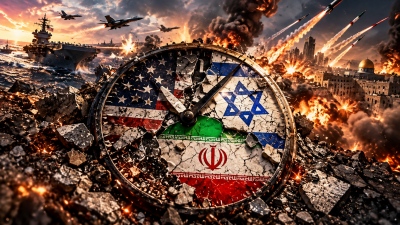
The third front is the Middle East. The new escalation between the US and Iran threatens, according to relevant estimates, about 20% of global oil exports, making the Strait of Hormuz one of the most dangerous points on the planet for the global economy. The interests of the three major powers, however, do not coincide. China, as a top hydrocarbon importer, has every reason to pursue the unhindered flow of oil. Russia, as a major energy exporter, has different economic pursuits. And the US maintains a critical strategic role in securing maritime lanes. Thus, behind the diplomatic handshakes may lie a massive energy bazaar.
4. Tariffs, sanctions, and trade war
The fourth front is the global economy. Russia and China have found themselves facing US sanctions and trade restrictions, while Donald Trump is called upon to balance between tariff policy and the need not to further fuel inflationary pressures in the US. Shenzhen can serve as the point where an attempt will be made to chart a new line for global trade. And here lies perhaps the greatest economic dimension of the "summit of the century." If Washington, Beijing, and Moscow agree on basic principles, the consequences can range from international markets and energy prices to supply chains and global trade.
"Yalta 2.0" – The nightmare of Brussels
It is no coincidence that the idea of such a meeting is already provoking intense discussions about a potential "Yalta 2.0." Professor Wu Xinbo, director of the Center for American Studies at Fudan University, believes that the choice of Shenzhen carries strong symbolism. The Chinese megalopolis serves as a symbol of modern China's economic and technological power. Holding a meeting of this level there could, according to him, underline that critical global crises no longer necessarily need to be handled exclusively through traditional Western institutions. Even more concerning is the assessment of Thomas Christensen, senior fellow at the Brookings Institution and former deputy assistant secretary of state for East Asian and Pacific affairs at the US State Department. As he argues, Donald Trump thinks in terms of grand bargains and wishes to appear as a global peacemaker. The real question, however, is what a potential understanding among the three could mean. For European NATO allies as well as US partners in Asia, there is a risk—as Christensen points out—that Putin, Xi, and Trump will attempt to agree on new spheres of influence. Of course, a trilateral meeting does not automatically mean an agreement. Yet the very image of Putin, Xi Jinping, and Donald Trump sitting at the same table would constitute one of the most powerful geopolitical snapshots of recent decades. Ukraine, Taiwan, Iran, Hormuz, sanctions, tariffs, energy, and spheres of influence could find themselves on the same agenda. And if a new informal compromise between the three major powers emerges from Shenzhen, the question will be inevitable: Is the world entering a new era of geopolitical balances or facing a new "Yalta 2.0" style agreement? The only certainty is that if the "Big Three" ultimately sit together in Shenzhen, the rest will wait to see what was decided for them.
www.bankingnews.gr





Σχόλια αναγνωστών